Accurate temperatures, both in the oven and the turkey are important for quality and safety. A meat thermometer is the cook’s best friend when it comes time to prepare a meal.
Here are some guidelines to ensure thermometers are properly used.
Check the oven thermostat and oven temperature to verify the oven setting. Recalibrate if necessary because a 25 degrees F. variation can make a five percent difference in cooked turkey yield. An oven that is too hot will dry and shrink the bird.
Recent NTF surveys indicate only 38 percent of home cooks use a meat thermometer to determine the doneness of a turkey and/or stuffing. In fact, every turkey should be checked with a thermometer to ensure quality and safety.
The current turkey breeds yield a higher proportion of white meat which cooks faster than dark meat. Other factors, including oven calibration, roasting pan dimensions, and starting turkey temperatures affect the length of time it takes for a turkey to reach the correct internal temperature for doneness.
When purchasing a thermometer, look for an easy-to-read dial, made with stainless steel and a shatterproof clear lens. Meat thermometers that can be calibrated for accuracy and digital thermometers are good choices. These types of thermometers are available at grocery, kitchen and hardware stores.
Oven-proof Thermometer
This should be inserted into the turkey at the beginning of the roasting time and remain inserted in the bird throughout the cooking time. The temperature indicator will rise slowly as the turkey cooks. An oven-proof thermometer is ideal for the whole turkey and the turkey breast. Be sure to sanitize the thermometer before each use. Wash it; then immerse the stem in 170 degrees F. water for 30 seconds or wipe with a sanitizer. You may sanitize the stem with a mild solution of chlorine bleach and water or an antibacterial kitchen cleaner. Rinse with clear water before inserting into the turkey.
Instant-read and Digital Thermometers
These thermometers are not designed to stay in the food during cooking. If you use this type, pull the turkey out of the oven far enough to insert the stem about 2-1/2 inches into the thickest part of the bird but not touching the bones or roasting pan. The sensing tip is a small indentation located about 1-1/2 inches from the end of the stem and must be fully inserted into the bird. (Look for a tiny dimple on the stem.) The temperature should register in about 15-20 seconds. Wipe with a sanitizer after each use and before the next use.
Pop-up Thermometers
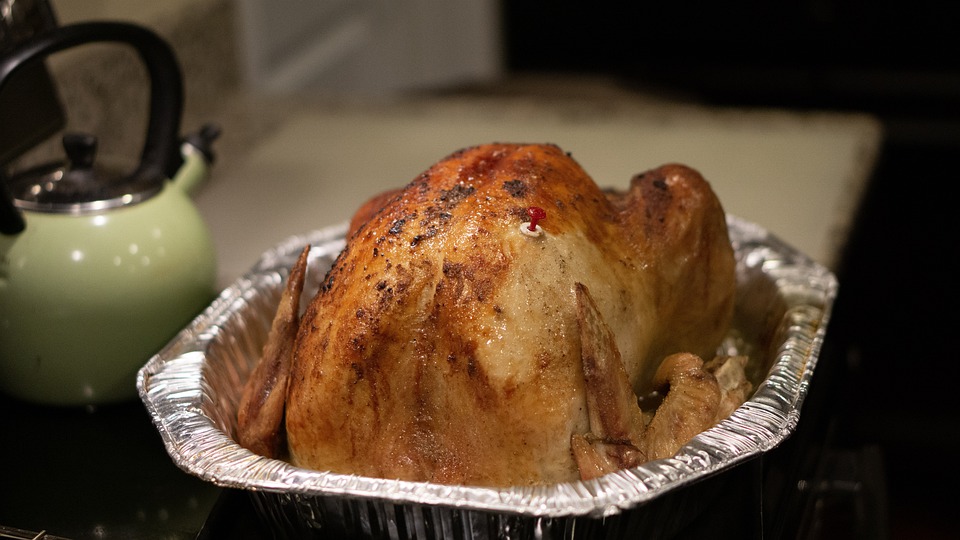
These are commonly found in the whole turkey and turkey breast. The ‘pop-up’ thermometer device indicates the turkey has reached the final temperature for safety and doneness. Experts suggest the temperature be verified with a conventional thermometer.
Check for Thermometer Accuracy
The accuracy of both new and old oven-proof, instant-read and digital thermometers should be verified and the thermometer calibrated. Ideally, these thermometers should be calibrated when first purchased as well as checked for accuracy before the holiday rush. Accuracy can be altered if the thermometer has been exposed to extreme temperature changes or has been dropped. There are two simple ways to test for accuracy.
Ice-Point Method
In a cup prepare a 50/50 mixture of ice and water to form a water slush. Place at least two inches of the thermometer stem into the cup, making sure the sensing tip is fully inserted. The tip should not touch the bottom or side of the cup. Wait about five minutes or until the needle is steady and verify the needle registers 32 degrees F. If the needle does not register 32 degrees F., an adjustment should be made by turning the small nut on the back end of the dial.
Boiling Point Method
Fill a pan with about three inches of water and bring to a rolling boil. Place at least two inches of the thermometer stem into the water, making sure the sensing tip is fully inserted. Use caution to avoid burns. The tip should not touch the bottom or side of the pan. Wait about one minute or until the needle is steady and verify the needle registers 212 degrees F. (NOTE: Water boils at a lower temperature at higher altitudes, for example, 202 degrees F. at 5,000 feet.) If the needle does not mark the boiling point, an adjustment should be made by turning the small nut at the back of the dial.
Proper Placement
An important part of using any thermometer is the proper placement in the turkey. Insert the thermometer 2-1/2 inches in the deepest portion of the turkey breast or into the inner thigh near the breast. Make sure the thermometer does not touch a bone. When inserting the thermometer in the turkey breast, insert it from the side. The thermometer is easier to read and more accurate than when inserted from the top.
Internal Temperature
The internal temperature should reach 170 degrees F. in the breast or 180 degrees F. in the thigh and 160 to 165 degrees F. in the center of the stuffing. Both the NTF and the USDA recommend using a meat thermometer to ensure a delicious and safe holiday feast.